
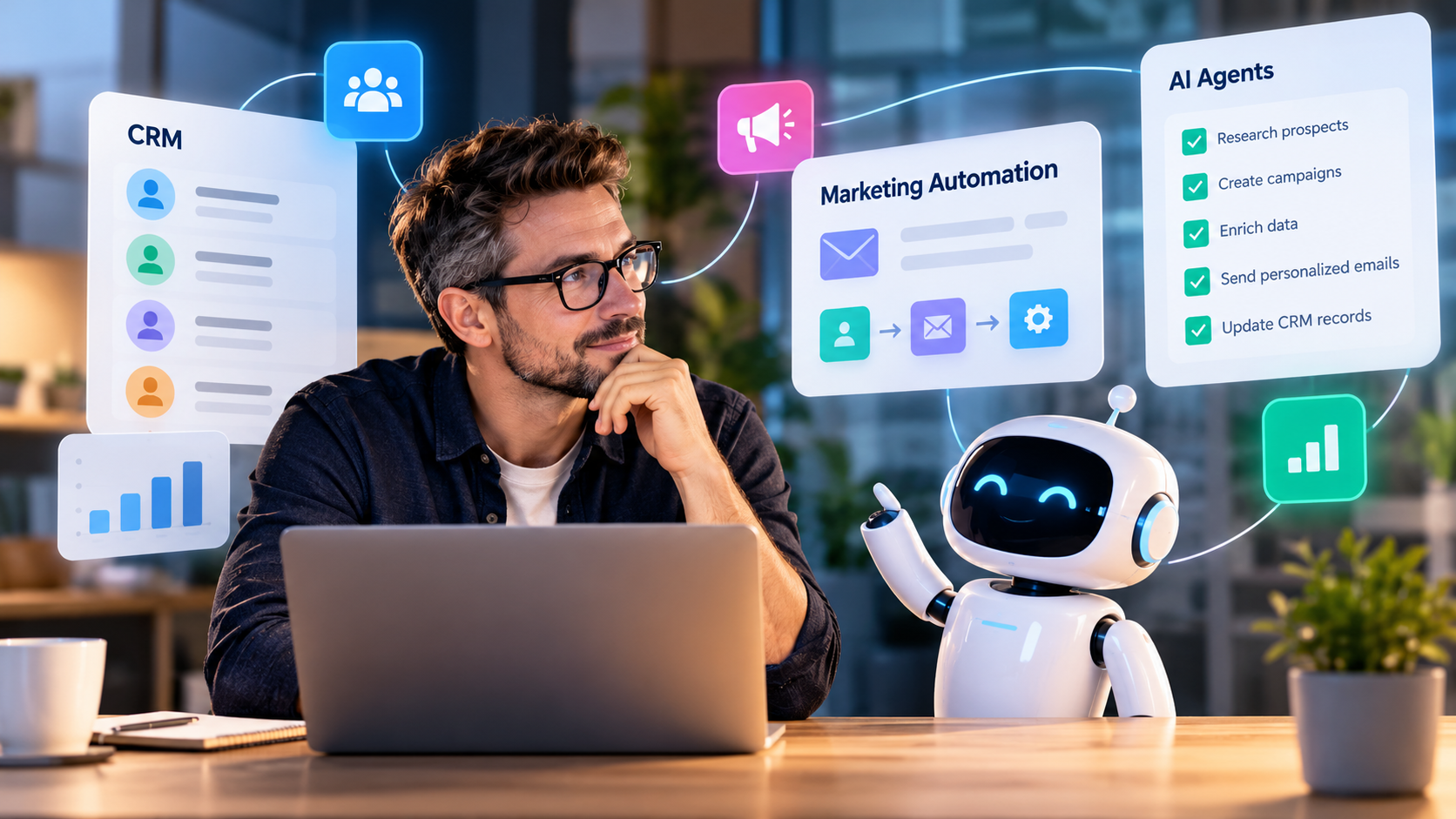
TL;DR: Businesses still need CRM and marketing automation, but AI could change how they use these platforms, how many licenses they need, and how they pay for them.
In short, if 100 employees need CRM data, do all 100 need a paid license? What if they could get the information they need through Slack, dashboards, or AI assistants without logging into the CRM? As AI takes on more work, it’s worth questioning whether traditional software licensing still makes sense.
AI is changing how companies use software, how vendors charge for it, and how much work people need to do themselves. But businesses still need CRM and marketing automation. So what exactly is changing?
I’ve spent years working with marketing technology, including Salesforce and Pardot, now called Marketing Cloud Account Engagement. I understand the systems, the integrations, the workflows, and the amount of work that goes into making everything run properly.
But I’m still trying to wrap my head around what the next phase looks like.
And I suspect a lot of marketing operations teams are asking similar questions.
The software industry is going through a major transition. Companies are rethinking their products, pricing models, organizational structures, and how they deliver value to customers.
AI is a big part of that conversation.
But here’s what I keep coming back to: If the software is doing more of the work, will companies need to buy and use it in the same way they do today?
The CRM isn’t optional. The vendor might be.
Here’s where I keep coming back to the practical reality of running a business.
You need somewhere to manage customer records, track opportunities, understand relationships, coordinate sales activity, and measure what marketing is doing. You need systems to capture leads, send emails, run nurture programs, and track what happens after someone responds.
You can change the tools. You can consolidate them. You can automate more of the work.
But you can’t just decide you no longer need any of those capabilities.
A company might use Salesforce, another CRM, or a combination of platforms. It might run its marketing automation through Account Engagement, Hubspot, or a collection of specialized tools connected to its CRM.
The names change. The operational requirements don’t disappear.
This is why I don’t think the most interesting question is whether AI will eliminate the need for CRM or marketing automation.
It’s whether AI will change which platforms companies choose, how much they pay for them, and how many people need direct access.
Those are three very different questions.
What if fewer people need a CRM seat?
This is where things get interesting.
Traditionally, software companies have made a lot of money by selling subscriptions, often priced according to the number of users who need access.
If 100 employees need to work directly in a CRM, you may need 100 appropriate licenses.
But what if all 100 employees don’t actually need to work inside the CRM?
Imagine a sales manager who wants a daily pipeline summary. A marketing director who wants campaign performance. An executive who wants to know which opportunities are moving and which ones are stuck.
Do all of those people need to log into Salesforce to get that information?
Maybe. But maybe not.
What if the information they need is delivered through Slack, an internal dashboard, or an AI assistant like Claude or ChatGPT?
An employee could ask, “Which opportunities in the retail segment haven’t had a follow-up in two weeks?” The system retrieves the relevant information and returns a useful summary.
The employee gets the answer without navigating a CRM, learning its interface, or building a report.
Multiply that across an organization and you start to see the possibility.
The CRM remains essential, but fewer employees might need to use it directly.
That could change how companies think about software licenses.
Of course, this isn’t a magic loophole that makes CRM access free. Integrations require setup, authentication, permissions, and ongoing maintenance. API access can have licensing and usage requirements, and an AI assistant needs to respect the same data access rules as other applications.
Some platforms offer API-only or integration-specific licenses for system-to-system connections. But those aren’t automatically substitutes for licenses for people who need interactive access to CRM functionality.
And not every Slack integration or AI connection automatically removes the need for a paid seat.
Still, the underlying question is legitimate: If employees can get what they need through another interface, how many full CRM licenses does the business really need?
The seat-based pricing question gets even bigger with AI agents
Now take that idea one step further.
What happens when AI doesn’t just retrieve information but actually does the work?
Imagine an AI agent that researches a prospect, enriches a record, drafts a personalized email, updates a field, routes a lead, and schedules a follow-up. A human reviews the important decisions, but the agent handles much of the repetitive work.
That changes the economics of software.
In the old model, a company might pay for software so an employee can perform those tasks. In an AI-enabled model, the company might increasingly pay for software that performs the tasks on the employee’s behalf.
The pricing conversation could shift from:
- How many employees need access?
- Which features do they need?
- How many seats should we purchase?
Toward questions like:
- How much work can the platform complete?
- How many conversations can an AI agent resolve?
- How many records can it enrich?
- How much time does it save?
- What does each completed task cost?
We’re already seeing software companies experiment with usage-based pricing for AI features and agents, alongside traditional subscriptions.
Salesforce, for example, is investing in Agentforce, while other enterprise software vendors are developing their own AI agents and automated workflows.
The big platforms are exploring how to monetize the work their software performs, not just the interfaces people use.
And that creates a potentially awkward situation for the vendors.
If AI helps customers become more productive with fewer people, those customers may need fewer seats. Usage-based pricing could make up some of that difference, but only if customers believe the additional cost is justified by the value delivered.
The challenge is to make the new model attractive without making the bill unpredictable.
The other possibility: companies start consolidating their tech stacks
There’s another path that doesn’t require AI to replace anyone.
Companies have spent years building increasingly complicated technology stacks. One platform manages sales. Another handles marketing automation. A third enriches data. Another handles customer service. Reporting tools pull everything together.
And then someone has to make the whole thing work.
I know how much effort goes into that last part.
When budgets tighten, leadership starts asking reasonable questions. Are we paying for overlapping capabilities? Does every department need its own tool? Could we get more from the platform we already own? Are we paying for functionality nobody uses?
AI could accelerate those conversations.
A company might decide to consolidate several tools into one platform. Another might keep its existing systems but put an AI layer on top of them. A third might replace a collection of point solutions with a more integrated stack.
There isn’t one answer for every company.
Large organizations have complex data models, compliance requirements, integrations, reporting needs, and years of accumulated business processes. Switching platforms isn’t as easy as canceling a subscription and importing a spreadsheet.
Even smaller businesses can discover that a supposedly simpler platform doesn’t support a critical workflow they depend on.
So I don’t expect every company to rush toward a single platform.
But I do expect more scrutiny of what each tool contributes, where capabilities overlap, and whether the overall stack is worth the cost.
The software category may remain essential while individual vendors face much tougher competition.
What does this mean for marketing operations?
This is the part I’m most interested in.
Marketing automation has always involved more than sending emails. It connects data, audiences, campaign activity, lead scoring, sales handoffs, reporting, and follow-up.
The platform is only one part of the system.
If AI makes it easier to build campaigns, analyze results, research audiences, and coordinate follow-up, the work of marketing operations could change significantly.
Some tasks that once required a specialist to navigate several tools might become automated workflows. People could spend less time manually moving information around and more time deciding what should happen, why it should happen, and whether it worked.
But automation doesn’t eliminate the need for sound architecture.
Someone still needs to decide which records are trustworthy, how duplicate data is handled, what qualifies as a sales-ready lead, who can access customer information, and how campaign performance is measured.
Someone needs to make sure the AI agent isn’t sending the wrong email to the wrong person or updating a CRM record with unreliable information.
In fact, as more work becomes automated, the consequences of bad data and poorly designed processes could become even more significant.
The technology may do more of the execution, but the systems still need to be designed, governed, and measured.
That’s one reason I’m watching this transition closely. I don’t think the future of marketing operations is simply fewer tools or fewer people. I think it could involve a different balance between human judgment, automated execution, and the infrastructure connecting everything.
I’m watching this play out in real time
I work with Salesforce and marketing automation, so I have a practical reason to pay attention to these changes. But I’m not convinced anyone has the whole picture figured out yet.
A few questions keep coming to mind.
Will companies eventually pay less for software because fewer employees need direct access, or will usage-based AI pricing replace much of that lost revenue?
Will AI assistants become the primary interface for business software, with CRM and marketing automation platforms increasingly operating behind the scenes?
Will companies consolidate their technology stacks, or will AI make it easier to connect a wider range of specialized tools?
And what happens to marketing operations when creating campaigns, building workflows, researching prospects, and analyzing results becomes dramatically faster?
I can imagine a future where a marketer describes a campaign, an AI system assembles the audience, develops the creative, builds the email and landing page, configures the automation, and prepares the reporting.
The marketer reviews the work, makes decisions, and improves the strategy rather than spending weeks coordinating every step manually.
Actually, I saw a demo along these lines at Dreamforce three years ago.
The interesting question is how long it takes to move from an impressive demo to something marketing teams can reliably use in their everyday work.
We’re getting closer to that possibility, but there is still a difference between demonstrating a capability and delivering a dependable, end-to-end workflow inside a real business.
The question isn’t whether businesses still need CRM
They do.
They need customer data, marketing automation, sales processes, reporting, and the systems that connect them. What may change is how those capabilities are delivered, how people interact with them, and how vendors charge for them.
I’m not ready to declare that seat-based software is dead, that AI agents will replace traditional CRM interfaces, or that every company needs to rethink its entire tech stack tomorrow.
I’m interested in seeing what happens next.
Because if AI changes how work gets done, it will almost certainly change how businesses buy the technology that makes that work possible.
And for those of us working in marketing operations, Salesforce, and marketing automation, that’s worth paying attention to.